Incorrect gate operation damaged the gate frame causing inoperability
Publish date
12 October 2026
Case ID#
3372
Title
Incorrect gate operation damaged the gate frame causing inoperability
Nation
England
Regulator reference no.
560
Legal status
Statutory
Reservoir type
Non-impounding
Reservoir capacity
25,000 - 99,999m3
Year of construction
1990 - 2009
Main construction type
Earth fill embankment
Dam height
5 - 9.99 metres
Dam flood category
A
Hazard class
High-risk reservoir
Reservoir use
- Flood risk management
Owner type
Public body
Date & Time of incident
07 August 2027 - 12:00
Date incident closed
08 August 2027
Observations that caused the incident to be declared
Describe the incident
This site is classed as an impounding flood storage reservoir to prevent downstream flooding during high rainfall. It is mostly dry with a stream running through and only floods the reservoir area in extremely high flows. The outlet is controlled by a hydraulicly operated gate which sits halfway open. This allows a steady flow of water whilst managing downstream flood risk. The gate has stops which rest on a beam, called its 'home position'. this is to prevent the gate closing during a loss of hydraulics or hydraulic creep.
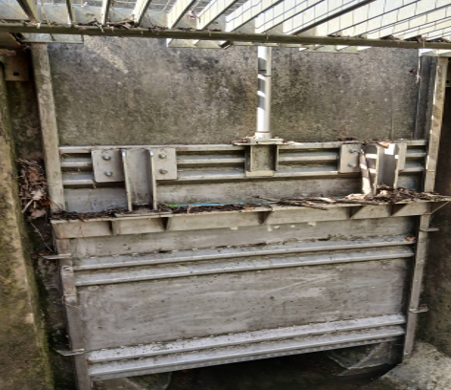
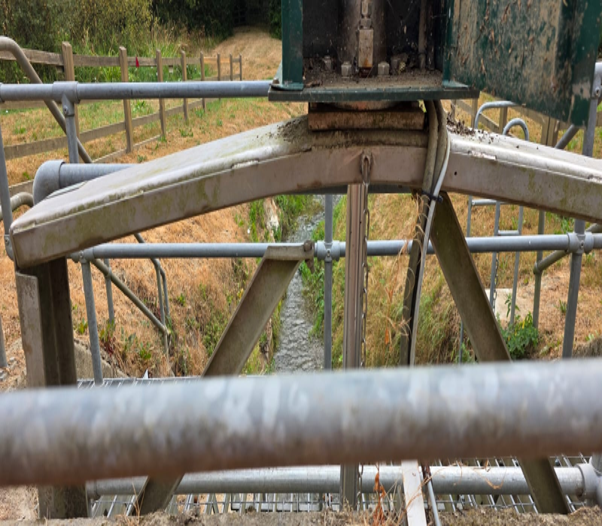
During a planned maintenance event, the operational key switch was moved from auto to manual and the gate was operated to close. However, the gate was still resting on the stops. With the pressure exerted on the stops, they did not move which caused the frame to distort. The frame bowed upwards and the strengthening bars broke away from the locating points on the frame. The Reservoir was empty of the time of the event so there was no uncontrolled release of water caused by the damage to the structure. There is no potential for this to have been the case, and the damage solely effects the ability to drawdown water levels during flood conditions.
The damage was reported immediately to the Supervising Engineer by phone with further details supplied by email later. The undertaker is working with contractors to repair the damage, requesting it to be complete prior to the winter flood season.
The penstock door remains in the 'home position and is resting on it's mechanical stops. This means it will impound flood water in the reservoir as intended, and serve its purpose in terms of flood risk management. It cannot, however, be raised from its home position. In any event where opening of the penstock is required to draw down the reservoir, it cannot currently be operated. There is an Emergency Flood Plan (Onsite Plan) in place for the site, which contains recommendations for pumping to drawdown water levels. This plan would be implemented in the unlikely event of drawdown being required before repairs are complete.
Supporting photos
Natural processes which initiated or contributed to the incident
- None
What were the main contributing factors to the incident occurring?
Dam factors
External factors
- Human error
Shortcomings
- Human error
- Process or procedural shortcoming
What was the root cause of the incident?
The penstock was incorrectly operated (switched to manual and set to close) when it was already resting on its stops, which caused distortion of the top member of the gate frame.
The damage occurred during planned, routine maintenance by external contractors.
Impacts on the reservoir
- Failure or damage to valves, gates, penstock
Supporting photos
Describe any human factors which influenced the incident
The penstock was incorrectly operated, which caused the incident.
Describe any instrumentation at the reservoir and how this was used in warning of the incident or providing monitoring during the incident
Was instrumentation effective leading up to and during the incident?
Yes
Describe any assistance by external parties and impacts on the downstream population
None
Summary of studies or investigations undertaken
The cause of the issue was apparent. The repairs involve the following steps:
Recovery
1. Remove the hydraulic cylinder and top of gate with HIAB
2. CARE must be taken with the cylinder as the positional instrument on top is expensive and has a lead time of 26 weeks
3. Contractor to straighten the top of the gate bracing brackets , and twisted side of gate.
4. Return, replace top of gate and hydraulic cylinder with HIAB
The undertaker has also introduced mitigations to minimise the risk of a similar event happening:
Prevention
1. Remove manual button for down , or replace with a key switch
2. Reduce hydraulic pressure if possible
3. Toolbox talk training for the team talking through operational manual
Supporting photos
Lesson 1
- Human factors
- Mechanical / electrical
Ensure that specific / individual personnel are inducted to site, and familiar with the operation of the structure.
Lesson 2
- Human factors
- Operation and maintenance
Where mechanical operation creates inherent risk of failure, identifying where the risk can be designed out reduces the chance of these errors happening.
Following the ERIC (Eliminate, Reduce, Isolate, Control) principles, this incident could have been avoided (and will be in the future) b:
Eliminating the risk (removing the 'down' button, or replacing with a key switch)
Reducing the impact (reducing hydraulic pressure)
Control (Toolbox talk for all operatives and updating the operational manual)